

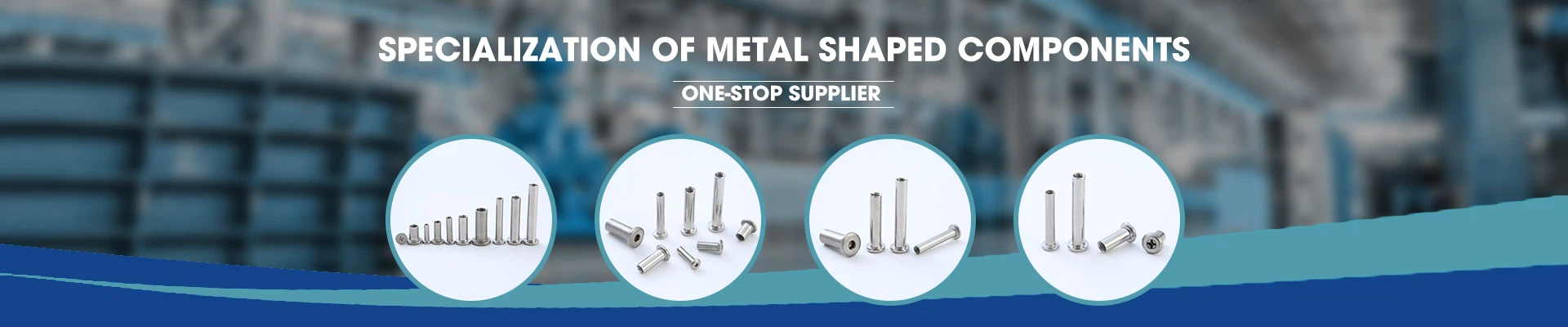
The main purpose of rivets is to connect and rivet objects, and they are an important fastener for connection.
1. Main application areas
Industrial manufacturing:
In the automotive, aviation, shipbuilding and other industrial manufacturing, rivets are widely used to connect and fix metal plates. For example, the connection point between the beam and the frame in the body structure usually uses rivets to fix the relative position relationship between steel plates or metal plates.
When the stability and reliability of steel structural parts are required to be high, riveting will also be used to improve the strength and stability of the connection.
Construction industry:
In the construction industry, rivets are often used to connect materials such as steel structures and aluminum alloy curtain walls.
In the process of bridge construction and the installation and fixing of exterior wall decoration materials of large buildings, different types of rivet products are also needed to ensure that the components can be tightly connected to achieve the load-bearing capacity and aesthetic effect required by the design.
Electronic equipment manufacturing:
In the manufacture of electronic equipment, rivets are used to fix components such as circuit boards and radiators, which require stable connections to ensure the normal operation of electronic equipment.
Since electronic equipment has high requirements for weight and volume, lightweight and high-performance rivets have become an ideal choice.
2. Specific uses of different types of rivets
Semi-round head rivets: Mainly used in riveting occasions with large lateral loads, and are the most widely used.
Flat cone head rivets: Because the rivet head is large and corrosion-resistant, it is often used in riveting occasions with strong corrosion such as hulls, boiler water tanks, etc.
Countersunk head rivets and 1200 countersunk head rivets: Mainly used in riveting occasions where the surface must be smooth and the load is not large.
Semi-countersunk head rivets and 1200 semi-countersunk head rivets: Also suitable for riveting occasions where the surface must be smooth and the load is not large.
Flat head rivets: Used in riveting occasions with general loads.
Flat head and oval head rivets: Mainly used in riveting occasions of metal sheets or non-metallic materials such as leather, canvas, and wood.
Large flat head rivets: Mainly used in riveting occasions of non-metallic materials.
Semi-hollow rivets: Mainly used in riveting occasions with small loads.
Headless rivets: Mainly used in riveting occasions of non-metallic materials.
Hollow rivets: light weight and weak nail heads, used for riveting non-metallic materials with low load.
Tubular rivets: used for riveting non-metallic materials without load.
Nameplate rivets: mainly used for riveting nameplates on machines, equipment, etc.
Blind rivets: especially suitable for riveting occasions where ordinary rivets (riveting must be done from both sides) are inconvenient, and are widely used in construction, automobiles, ships, aircraft, machinery, electrical appliances, furniture and other products.
Strike rivets: suitable for riveting occasions where ordinary rivets or blind rivets are inconvenient to use. Flat round head strike rivets are usually used. Countersunk strike rivets are suitable for riveting occasions where the surface needs to be smooth.